
Listen to Cuvama's interview with Dan Head about why Sales Discovery is the number one reason why a sales team is inefficient, unproductive and loses deals.
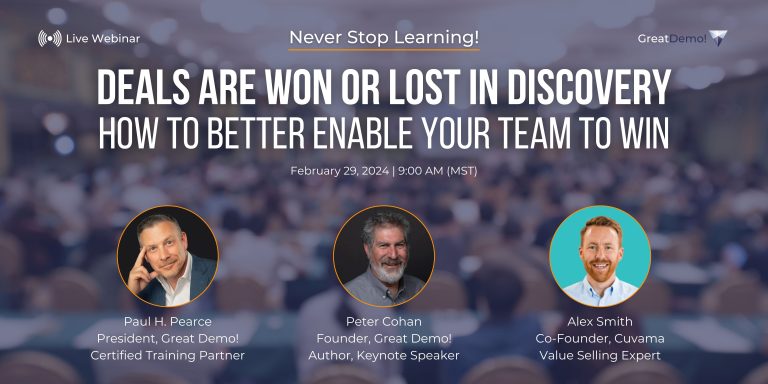
Deals are won or lost in discovery. But how do you ACTUALLY ensure you or your team do discovery consistently well? In this webinar with Great Demo we cover how to enable your Sales Team to execute great discovery, every time.

This report shares the insight from Cuvama’s research into why B2B SaaS sales reps struggle in discovery (despite investment in training, enablement and methodologies).

Sales teams are often more concerned about “doing discovery” than about the quality of the discovery done. Ultimately, poor discovery costs your business money. It wastes your sales team’s time and resources and makes your entire business less efficient.

This interview and accompanying blog with Peter Cohan, Founder of Great Demo!, covers how to avoid the number one reason for deals ending up in No Decision; reps failing to uncover Critical Business Issues.

Buying groups are getting larger and more complex. Even smaller $50k SaaS decisions often involve +10 stakeholders. So if you’re a B2B seller and don’t have ‘guiding buyer consensus’ at the top of mind – then you’re probably toast...

CEOs and revenue leaders across enterprise SaaS all grapple with forecasting revenue numbers. Getting forecasts wrong means agitated investors and difficulty making strategic decisions. Leaders should be able to look at a pipeline and say that a deal has X chance of closing within X months...

The attributes required for successful enterprise software sales in 2021 have changed radically. I’ve seen a seismic change in buying behavior in the last 18 months that has fundamentally changed the way we need to operate. That change is the growth in size of buying groups which are now twice or even three times the usual number…
MEDDPICC is arguably the most widely adopted sales framework within B2B sales. Find out how you can implement and scale MEDDPICC in across your sales team.
MEDDPICC is arguably the most widely adopted sales framework within B2B sales. Find out how you can implement and scale MEDDPICC in across your sales team.

Don't miss our ultimate guide to MEDDPICC. In this guide we provide a comprehensive overview of the most popular sales discovery methodology to help you implement it.
MEDDPICC is arguably the most widely adopted sales framework within B2B sales. Find out how you can implement and scale MEDDPICC in across your sales team.
Three workshop groups. Three shifts. None of them fully solved. Here's what 25 revenue leaders said has to change about AI in B2B sales - and why most teams haven't moved yet.

Three prices. Three commercial consequences B2B sales teams are already paying. Deals that never close. Performance gaps that stay hidden. Deal sizes that keep shrinking. Twenty-five revenue leaders sat in a room in London and mapped all three.
Three lies. Three assumptions most B2B sales teams are still acting on. Deploy AI, team gets better. More research, better discovery. Value is in our DNA. Twenty-five revenue leaders sat in a room in London and called all three out.

Cuvama and Genius Drive hosted 25 B2B sales and value leaders in London to explore the good, the bad, and the real-life use cases shaping how sellers and buyers engage.

Part 2 of a 3-part blog series exploring the current state of AI in B2B sales. Based on insights from Cuvama’s NYC event, this post uncovers where AI is genuinely adding value - and what’s still getting in the way.

Part 1 of a 3-part blog series unpacking real-world AI misfires in B2B sales. Based on insights from Cuvama’s NYC event, this post explores what happens when AI goes wrong - and what sales leaders need to do differently to get it right.
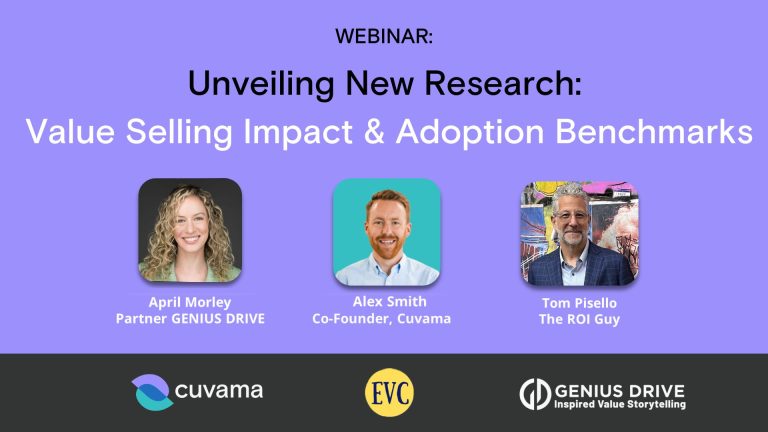
In this webinar with Genius Drive we reveal our latest research into the adoption and impact of value selling. Over 100 B2B SaaS companies participated in our study, allowing us to produce the first ever value selling benchmarks.
Deals are won or lost in discovery. But how do you ACTUALLY ensure you or your team do discovery consistently well? In this webinar with Great Demo we cover how to enable your Sales Team to execute great discovery, every time.