Across the B2B SaaS world, businesses, customers and CS teams in particular are tearing their hair out in order to drive ‘good adoption’ for the end-users. According to the value selling survey that we ran earlier this year with 100+ B2B SaaS companies, only 19% of salespeople regularly sell value. Yet when applied, value selling improves win rates by 48% and deal sizes by 35%. With this magnitude of impact on sales performance, the question remains, why are 80% of sellers not adopting value selling?
At Cuvama, we’ve seen this problem first-hand for ourselves and our customers. We’re very proud of all we’ve done, and continue to do, to drive salesperson adoption. It’s the core of our mission and strategy. Yet we’ll be the first to admit that it is not something we have ‘cracked 100%’ – despite adoption numbers that are 2-3x the market average. In this article, we’ll share our experience with solving for adoption and our unique approach to the problem.
The four adoption commandments
First, some things we have categorically established. Let me call them the 4 commandments of the adoption problem:
- It is NOT a trivial problem. Solving for adoption delivers game-changing results. Our research shows that for every 10% increase in your sales team adoption of vale selling, a business should expect to see a 10% increase in new business revenue.
- Expecting a ‘magic Product’ that can drive ‘immediate pull’ and solve the problem is a pipe dream. You’re looking for Aladin’s lamp people. Adoption takes more than just a great product.
- Having said that, a great product is the classic ‘necessary but not sufficient criteria’ to drive good adoption
- Read (1) again
The Cuvama approach to driving adoption
So how exactly have we gone about solving the adoption problem for our value discovery solution. I’ll break the rest of this article into 3 steps:
- Defining ‘good adoption’: arguably the biggest part of the problem
- Ensuring it can be measured
- Outlining a path (timelines) to good adoption
At this point, you have 2 choices. You can either read the rest of the article (correct answer). Or you can have a look at the slide below and take away the quick summary.
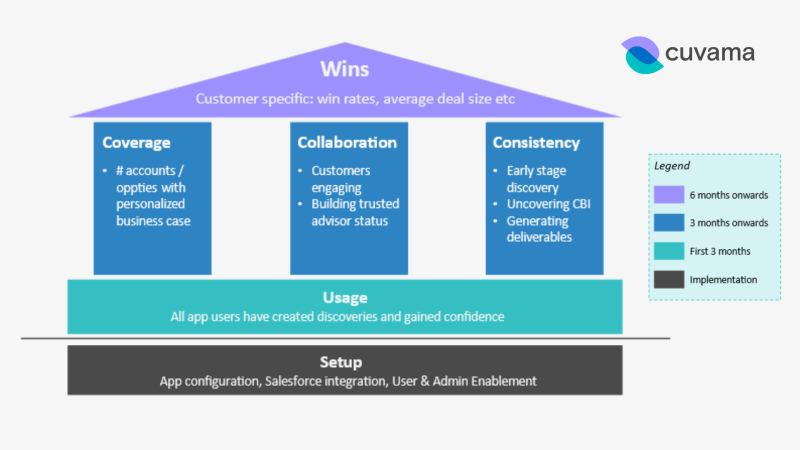
To solve a problem, we must first define it clearly.
So: what exactly does ‘good adoption’ mean for a value selling solution.
Usage
Obviously, it must start with Usage. Unless sales reps and other GTM teams are using the solution, we cannot claim good adoption. As a side-note, this basic first step is also where most products trip up. Because they become too ‘complex’ and ‘overwhelming’ for sales people, a majority is not willing to even give it a try. But as we have established with the ‘necessary but not sufficient’ product criteria before, an easy to use product with great UI (thanks Product and Engineering) is not the only ingredient needed in the adoption dish. Usage, is just the tip of the iceberg, or in the slide above, the foundation of the ‘House of Cuvama’
Coverage
The next step in defining good adoption is defining the ‘quality’ and ‘quantity’ of usage. These are the 3 pillars above. Quantity is denoted by Coverage. Great if most reps are using our Product, but are they using it all the time? If a rep has 10 deals where they should sell value, are they using Cuvama for 2 of them or 10 of them? This is where we measure Coverage. A pre-requisite to this is defining what kind of deals should be ‘in-scope’ e.g., new business and expansions, deals above a certain threshold size etc.
Quality is trickier. Someone may have used Cuvama for enough of their pipe. But not used it well. That can clearly not construe good adoption. We use 2 things as a proxy…
Consistency
All reps should use Cuvama early on in the sales cycle and do a guided discovery. Similarly, reps can generate ROI and value story slide decks using Cuvama. Discoveries where this consistent approach to good value selling is followed are, by definition, good discoveries.
Collaboration
We know value discovery should be collaborative with the champion and the case for change has to be the Champion’s, not ours. This is why we make it super easy for the Champion to access and edit the story directly in Cuvama. It follows, that discoveries where there is collaboration by the end-customer / champion, are high-quality discoveries and, definitely construe good adoption
Finally, being avid consumers of our own champagne, we must link adoption to value actually delivered for the customer. This is where we start looking at the Impact as the final step in ensuring good adoption. We are yet to come across a customer where high usage, good coverage and good levels of consistency and collaboration did not lead to the expected impact. However, good adoption needs to be defined not just as an input but also as an outcome. For a value discovery solution, things like win-rate and deal size denote the impact and are the cherry on the adoption cake (or the roof on the adoption mansion)
And as good CS teams, it is imperative to communicate this impact to the key stakeholders and drive a virtuous adoption cycle
Measuring adoption
Having defined the problem, and ensured that the customer agrees with this definition, the next step is to make sure we measure each of the components and set the right baselines and target. For some, it is straightforward; for others, we needed product investments to make sure we could measure them.
- Usage: # reps/GTM team members that use Cuvama every week / month / quarter. This is easy and is typically >80% each quarter, if not 100%
- Coverage: % of in-scope opportunities where Cuvama was used. Once ‘in-scope’ has been defined, this can be done with the right set of CRM integrations. Note that ensuring high coverage is extremely difficult, specially as sales teams become larger. That is both a good and a bad thing though. We have seen multiple customers realize a 7-figure impact attributable purely to Cuvama, within a few months of going live, even when coverage is at 15-20% levels. Which means the ceiling for the $$$ that can be unlocked is immensely high. Top quartile customers are able to ensure 70%+ coverage around the 6-9 month mark (again, size and company culture plays a big role here)
- Consistency: to measure this, we needed to define the use-cases that denote a good discovery and be able to track product features that enabled them. Thanks to the great work done by our Product teams, this is something we are able to do. Setting the right baselines here is key as the requirements for each customer are different
- Collaboration: we have a strong POV that end-customer engagement on Cuvama drives disproportionate impact in closing deals. We have seen this validated in terms of win-rates. As a result, we made considerable investments to both make it super simple for end-customers to access and collaborate within Cuvama, for reps to track the collaboration and for sales leadership to measure this. We see our top customers achieving 25-30% collaboration consistently (i.e., 25-30% of discoveries had the end-customer engage directly with Cuvama), without considering a basic ‘screen-share’ as collaboration. Top reps actually achieve over 50% collaboration, which again is unsurprising given the shifting buyer preferences to engage on digital channels
- Impact: classic click-bait. Most companies can measure this and websites are replete with wonderful stats about the great impact that can be shown. We’d love to say we are different but honestly, it is purely the rigour that sets us apart. We measure the impact on win-rates and deal-sizes every month (customers can of course, view this in real time) and consistently see a 15-20 pp improvement in win-rates and a 10-40% increase in deal sizes. This is also consistent with the expectations we heard from our survey around the likely impact of good value selling
Outlining a path to good adoption
Reader, I value you for bearing with me thus far. I truly do. I will also have to take you back to commandment (1). It is really not easy. The fact that I needed to write this much to just define the problem and articulate how to measure it should have made that obvious. However, we are all running businesses and do need to know the time and effort it takes to get to ‘good adoption’.
The correct and non-helpful answer: it depends.
Some data-points because you will refuse to accept the correct answer:
- We find the first 2-3 months post go-live are focused on driving up usage. This is where we look to make sure each ‘in-scope’ rep (not everyone would be in-scope if doing a phased implementation at a large sales organization) has at least been able to use Cuvama once and is comfortable with when / how to use and the features. By the end of 3 months, we should be seeing nearly everyone using Cuvama at least regularly or for some of their deals
- Months 4 onward, we can expect some early wins (good feedback from end-customers, growing comfort and confidence of sales reps, good collaboration stories, maybe a win if lucky) and broadcasting those becomes key to driving adoption. I’d say it would take at least a quarter, and usually more, for coverage and consistency / collaboration levels to reach target levels. Again, company size, culture and leadership buy-in are variables whose importance cannot be overstated
- Month 6 onward is where one would expect to start seeing some wins and tracking impact. Once 5-10 wins have been had, a coherent picture starts emerging. As said repeatedly earlier, we are yet to come across a scenario where the expected impact levels were not seen. If anything, they are often exceeded
To end with a classic click-bait anecdote, let me just say that for one of our top customers, when we got down to analyze the impact after 12 months (at renewal): we saw a 100X ROI that had been delivered (conservative estimate looking ONLY at wins attributable to Cuvama, not all wins where Cuvama was used).