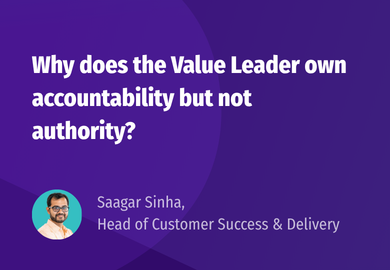
Why does the Value Leader own accountability for deal outcomes but have no authority over the sellers who determine them?
The accountability-without-authority structure of the Value Leader role is not a management failure to fix. It is a deliberate organisational design condition to understand. The practitioners who thrive build their program around that reality rather than against it, and recognise that the governed discovery motion is the one thing they can control even without seller authority.
Key takeaways
- The mandate gap, where the Value Leader is accountable for outcomes but has no reporting line into the sellers who produce them, is a design choice organisations make consistently, not an oversight.
- Influence-building advice isn’t wrong, but it operates at the wrong level: it produces exceptions with individual reps, while the mandate gap applies to every relationship at once.
- What the Value Leader can actually control is the governed discovery motion itself, made accessible, useful, and visible without requiring formal authority over sellers.
- Executive sponsorship changes the temperature of the structural condition but not the condition itself, and programs that depend on it are fragile when sponsorship shifts.
- Programs built to work within the mandate gap, rather than waiting for it to resolve, tend to be more durable because adoption follows usefulness rather than enforcement.
Why this matters now
The value practitioner six months into the role has usually reached a specific moment of clarity. They were hired to scale the value motion across the full pipeline. They were given a methodology, a budget for analysts, and a mandate that reads well on paper. They were not given a reporting line into the sales team, authority over rep behaviour, or a mechanism to enforce the discovery process they were asked to govern.
They have had the conversations with the Sales VP, made the case for earlier engagement, for better discovery discipline, for the value team being brought in before the demo rather than after the business review. Some of those conversations have gone well. Rep behaviour has not changed in proportion.
This is the point where most practitioners decide the problem is a management or relationship problem, that the right stakeholder engagement will eventually close the gap. Some of them are right. Most spend the next eighteen months learning that the gap is not primarily a relationship problem.
What does the mandate gap actually look like in practice?
The Value Leader is measured on deal outcomes, win rates, and the quality of the business cases that reach procurement. The sellers who produce those outcomes report to a Sales VP whose primary accountability is the current quarter’s number. Those two accountability structures are not aligned, and the misalignment is not accidental.
In practice, the mandate gap shows up in three specific conditions. The rep does not pull the value team in early because early engagement feels like overhead when the pipeline is full and the quarter is live. The value team produces a business case framework the rep uses selectively, taking the parts that fit the deal as they understand it and leaving out the discovery discipline that would have produced the validated inputs. The Value Leader is asked to explain why case quality is inconsistent across the pipeline, when the explanation requires naming a structural condition the organisation has chosen not to resolve.
Each of these is a manifestation of the same design: the Value Leader owns the methodology but not the behaviour of the people who execute it.
Why is the role designed this way, and is it intentional?
It is intentional, in the sense that organisations build it this way consistently enough that it cannot be attributed to oversight. The value function’s purpose is to govern a process, the discovery-to-case motion, that is executed by people who report to someone else. Giving the value function authority over that process would create a reporting conflict with the sales organisation, so organisations resolve that conflict by giving the Value Leader accountability for outcomes and influence over process, while preserving the Sales VP’s authority over the sellers who determine both.
The arrangement is rational from an organisational design perspective. It protects the sales organisation’s operational autonomy while creating a function whose job is to improve the quality of what that organisation produces. The cost of the arrangement falls on the Value Leader, who is accountable for outcomes they can influence but not control.
Understanding this as a design choice rather than an oversight changes the practitioner’s options. An oversight can be corrected. A deliberate design condition has to be worked within.
Why does 'influence without authority' advice fail to close the gap?
The standard advice for practitioners in accountability-without-authority roles is to build influence: earn credibility with the sales team, demonstrate value in individual deals, build relationships with the reps who are most receptive, and gradually expand the program’s reach through demonstrated impact. This advice is not wrong. Influence is real and it compounds.
The advice operates at the wrong level for the mandate gap. Influence is a tactic applied to individual relationships, while the mandate gap is a structural condition that applies to every relationship simultaneously. The Value Leader who has built strong relationships with the five most senior reps still has no mechanism to govern the discovery process on the forty other reps’ deals. Influence produces exceptions. The mandate gap produces the rule. Tactics applied to structural problems produce incremental results and require continuous re-investment to maintain.
What does working within the structure actually require?
It requires designing the program so that the value team’s contribution is accessible and useful to reps even without a formal authority relationship. The governed discovery motion that produces the first version of the business case, built from the discovery intelligence the rep captures and refined with the champion, gives the rep something they want to use because it makes their job easier, not because the Value Leader told them to use it. The program that scales is the one that reduces the rep’s effort rather than adding to it.
It also requires instrumenting the program so that the value team’s contribution is visible in the deal record. When the Value Leader can show the CRO what the governed discovery motion produced on a specific deal, the business case the CFO’s review turned on, the discovery intelligence that made the financial argument credible, the accountability conversation changes. The Value Leader is no longer claiming outcomes they cannot prove. They are pointing to a deal record that shows what they built and where it changed the trajectory.
Isn't the accountability-without-authority structure just a management problem that better executive sponsorship would solve?
Executive sponsorship helps. A CRO who actively enforces early value team engagement changes rep behaviour faster than any influence campaign the Value Leader can run independently. This is true and worth pursuing.
The mandate gap survives good executive sponsorship because it is structural, not interpersonal. The CRO who enforces early engagement this quarter is managing two or three other fires next quarter. The Sales VP who supports the value motion during the QBR is protecting their team’s autonomy at the next pipeline review. Executive sponsorship changes the temperature of the structural condition; it does not change the condition itself. The Value Leader who designs their program as if executive sponsorship is permanent will find it fragile when sponsorship shifts. The one who designs it to work within the structural condition will find it more durable than any single sponsor.
The governed discovery motion as the thing the Value Leader can control
The mandate gap is a condition on authority, not on methodology. The Value Leader does not control seller behaviour, but they do control the governed discovery motion, the process that produces the first version of the business case regardless of which rep is running the deal.
What that control looks like in practice comes down to three properties: the value team’s contribution is accessible, useful, and visible without requiring a formal authority relationship. Accessible, because the governed discovery motion is available to every rep on every deal, not only the deals where the value team was pulled in early. Useful, because it reduces the rep’s effort rather than adding to it. Visible, because the deal record shows what the motion produced, traceable by the CRO in a deal review.
Does executive sponsorship solve the mandate gap?
Executive sponsorship changes the temperature of the structural condition without changing the condition itself. A CRO who actively enforces early value team engagement accelerates adoption. A program that depends on that sponsorship to function is fragile when the sponsorship shifts, which it does, because executives manage multiple competing priorities. The program designed to work within the structural condition is more durable than any single sponsor’s tenure.
How long does it take to build a value program that works within the mandate gap?
The design choices that matter most, instrumentation of the governed discovery motion, program governance that reduces rep effort rather than adding to it, and deal record visibility that supports the CRO’s review, can be built into the program from the start. The compounding effect of those choices, in terms of the CRO’s evolving view of the program’s contribution, typically takes two to four deal cycles to become visible. The structural condition does not change. The evidence base the Value Leader can point to does.
The mandate gap is the condition you are working within. Understanding it clearly is the first step toward building a program that is durable rather than dependent on organisational goodwill that shifts. See what that program design looks like in practice, and how the governed discovery motion is instrumented to work within the structure rather than against it.
Frequently Asked Questions
Why does the Value Leader have accountability but no authority over sellers?
It’s a deliberate organisational design choice, not an oversight. Giving the value function authority over sellers would create a reporting conflict with the Sales VP, so organisations resolve it by giving the Value Leader accountability for outcomes and influence over process while sellers keep reporting elsewhere.
Does building relationships with reps close the mandate gap?
It helps individual deals but doesn’t close the structural gap. Influence is a tactic applied to specific relationships; the mandate gap applies to every relationship simultaneously. A Value Leader with strong ties to five senior reps still has no mechanism to govern discovery on the other forty reps’ deals.
What can a Value Leader actually control without seller authority?
The governed discovery motion itself. It can be designed to be accessible to every rep on every deal, useful enough that adoption follows because it reduces the rep’s effort, and visible in the deal record so the CRO can trace what it produced, all without requiring a reporting relationship.
Does executive sponsorship solve the mandate gap?
It changes the temperature, not the condition. A supportive CRO accelerates adoption while they’re paying attention, but a program that depends on that sponsorship becomes fragile the moment the CRO’s focus shifts elsewhere, which it will.
How long does it take to build a program that works within the mandate gap?
The key design choices, instrumenting the discovery motion and making its output visible in the deal record, can be built in from the start. The CRO’s view of the program’s contribution typically takes two to four deal cycles to shift, as the evidence base accumulates.